This site may contain copyrighted material the use of which has not always been specifically authorized by the copyright owner. We are making such material available in an effort to advance understanding of environmental, political, human rights, economic, democracy, scientific, and social justice issues, etc. we believe this constitutes a ‘fair use’ of any such copyrighted material as provided for in section 107 of the US Copyright Law.
In accordance with Title 17 U.S.C. Section 107, the material on this site is distributed without profit to those who have expressed a prior interest in receiving the included information for research and educational purposes. For more information go to: http://www.law.cornell.edu/uscode/17/107.shtml
If you wish to use copyrighted material from this site for purposes of your own that go beyond ‘fair use’, you must obtain permission from the copyright owner.
FAIR USE NOTICE FAIR USE NOTICE: This page may contain copyrighted material the use of which has not been specifically authorized by the copyright owner. This website distributes this material without profit to those who have expressed a prior interest in receiving the included information for scientific, research and educational purposes. We believe this constitutes a fair use of any such copyrighted material as provided for in 17 U.S.C § 107.
FAIR USE NOTICE FAIR USE NOTICE: This page may contain copyrighted material the use of which has not been specifically authorized by the copyright owner. This website distributes this material without profit to those who have expressed a prior interest in receiving the included information for scientific, research and educational purposes. We believe this constitutes a fair use of any such copyrighted material as provided for in 17 U.S.C § 107.
Former U.S. President Bill Clinton has been making the rounds to defend his policies while in office to support his wife’s run for President. The close working relationship that he and Hillary Clinton have infers a symbiosis that other ‘First Couples’ wouldn’t be jointly held accountable for. And in contrast to the oft offered argument that Mrs. Clinton isn’t responsible for her husband’s policies, she has taken responsibility (links below) for her role in developing, promoting and implementing the omnibus crime bill of 1994 that led to the massive buildout of the carceral state (mass incarceration) and for her use of the term ‘super-predator’ as racist slander against Black children.
When Bill Clinton was recently confronted by Black Lives Matter protestors he reiterated the talking points that he (and Hillary) used in 1994, that drug ‘gang’ violence was real, that his (and Hillary’s) interest was humanitarian, that many Blacks supported the crime bill and that the growth in incarceration rates for people of color was an unintended consequence. Left unsaid was that the crime bill was but one part of the Clinton’s opportunistic ‘dog-whistle’ strategy, that the policies tied to more than three centuries of racial repression in the U.S. and that regardless of whether the Clintons fully thought through the implications, they were willing to gamble with the lives of millions of Black and Brown youth for political gain.
Contemporary political rhetoric ‘works,’ to the extent that it does, by erecting walls between ideas, acts and policies that might otherwise be plausibly related. Basic physical security, as in freedom from violence for one’s person, family, neighbors and community, is a human right in a most basic sense. It is also the human right that has been most tightly circumscribed throughout American history. The American ‘story,’ as in the history written by the dominant culture, has been of White America ‘under attack’ from hostile indigenous peoples and inner-city ‘criminals’ whereas the overwhelming preponderance of actual violence has been committed against the indigenous population, kidnapped Africans held in slavery and their descendants.
This same disjoint ‘history’ is true of American military adventures overseas, always undertaken in official explanations to benefit those being bombed, sanctioned, starved, imprisoned and forced to migrate. Bill Clinton spent most of his two terms in office bombing and sanctioning Iraq to ‘contain’ former CIA ‘asset’ Saddam Hussein as Mr. Hussein continued to eat well and sleep comfortably at night. It was the Iraqis who were least able to defend themselves who were bombed, starved, and from whom life-saving medicines and medical care were withheld. Somewhere between 300,000 and 500,000 innocent Iraqis— mostly women and children, were killed by Mr. Clinton’s bombs and sanctions.
This context is necessary because when Bill Clinton chose to defendhis and Hillary Clinton’s omnibus crime bill and its social consequences he framed it, once again, as a domestic ‘humanitarian intervention.’ The localized ‘truth’ that Mr. Clinton used to do so— that freedom from violence is a basic right that ‘even’ the communities subsequently targeted with repressive policing, racially biased drug laws and mass incarceration deserved, removes the broader context of American racial history. Alternatively, without an antique-progressive racial or genetic theory of ‘crime,’ why would liberal Democrats choose police repression and creation of a carceral state before first resolving the political and economic exclusion that correlate 100% with the communities suffering from ‘internal’ violence?
In history, the first ‘professional’ police department in the U.S. was created in Charleston, S.C. from mercenary ‘slave patrols.’ Following the Civil War ‘Black laws’ (codes) were used to maintain civil control over nominally freed slaves for purposes of creating neo-chattel conditions of expropriated labor and social control. Jim Crow used racially targeted laws, policing and carceral policies as tools of civil enforcement of racial repression. Ronald Reagan began his 1979 campaign for President in Philadelphia, MS, where in 1964 three civil rights activists were brutally murdered by local police working with the Ku Klux Klan. It was in this historical context that in 1994 Hillary Clinton used the term ‘super-predator’ as racist code for poor black youth to sell the omnibus crime bill.
In fact, the Clinton’s spent most of Bill Clinton’s two terms using coded racist themes—‘dog-whistle’ politics, to benefit politically through raising racial animosity and repression. Mr. Clinton’s welfare ‘reform,’ framed as ‘ending welfare as we know it,’ followed directly from Ronald Reagan’s racist caricature of the ‘welfare queen’ living high on the public dime. Mrs. Clinton’s ‘super-predators’ likewise had implied race and class that tied to racist themes of Black ‘supermen’ all ‘hopped up’ and impervious to pain, bullets and ‘normal’ human emotions. That the overwhelming preponderance of American racial violence has been perpetrated against Blacks and the indigenous population seems a murderous flaw in the dominant culture id— complete reversal of factual history into misdirected fear.
Put forward as support for the Clinton’s policies is that many Blacks buy-into dominant culture stereotypes much the same as White people do. In areas where drug violence persists, Blacks are often featured on the local news thanking the police for arresting the kids who have been shooting up neighborhoods and killing one another. To state the obvious: these circumstances are tragic and require social resolution. However, the argument that repressive policing, racist drug laws and mass incarceration are socially constructive solutions in no way follows from the tragedy of the circumstances. The Clinton’s ‘market-based’ solutions to poverty ultimately destroyed the near totality of Black wealth and many inner city neighborhoods in the housing bust.
Most adult Americans live no more than a ten minute walk or drive from a place where, for less than twenty dollars, they can buy a lethal dose of a debilitating and violence inducing drug. Eighty-eight thousand people drink themselves to death every year in the U.S. Two hundred and ten thousand people die each year from preventable medical errors. The worst case scenario under the racist hysterics of ‘super-predator’ theories was that 6,000 people per year would die. In other words, Americans are 35X more likely to die from an accident at the doctor’s office than they were in 1994 to die from ‘gang’ violence. The Clintons knew exactly what they were doing when they used coded racist appeals to ‘peel away’ White suburban voters from national Republicans. The strategy worked politically for them at the time, never mind the body-count of destroyed lives they left behind.
Drug (alcohol) Prohibition in the 1920s produced a violent culture of (White) alcohol distributors that used gun violence against one another, the police and occasionally innocent bystanders. No racialized pseudo-science was created in response around a White predisposition toward wanton murder. The social ‘choice’ of which drugs are legal or illegal has always been a proxy for racial and cultural politics. As Dan Baum wrote recently in Harper’s, Richard Nixon’s rationale for launching the ‘war on drugs’ was to provide the Federal government with plausible cover to spy on, disrupt, arrest and otherwise impede Black communities and the anti-war Left for political gain. From its inception the war on drugs has been a racialized tactic of political repression waged by the authoritarian Right, often with the help of progressive ‘science.’
Many commentators have pointed the sudden compassion that White Americans found for the drug-addicted as heroin has once again become a major cause of death among Whites. Portugal decriminalized all drugs(heroin, methamphetamine, etc.) fifteen years ago, at about the same time that the Clintons were leaving office. Since then drug usage in that country has declined substantially (link above). Canadian physician Gabor Mate has been (plausibly) arguing for several decades now that drug addiction is a symptom, not a cause, of social dysfunction. Were the Clinton’s intention other than political gain through racial division and racist repression their lack of political imagination might have only been depressing, rather than socially catastrophic.
The broader frame of the American carceral response to social problems is inextricably tied to three centuries of racial repression. Bill Clinton slaughtered 300,000+ innocent (Brown) women and children in Iraq and social circumscription places those deaths in the category of ‘acceptable’ behavior. But when Black children tossed onto the social garbage heap express a tiny fraction of the social pathos hurled at them they are suddenly too dangerous to be left un-imprisoned. To reiterate, in the context of broader threats to life and livelihood, the threats to the children the Clinton’s imprisoned far outweighed any plausible threats from them. Had Bill and Hillary Clinton given the slightest crap about these children they would have been increasing funding to their communities, not cutting it as they were.
In an interview that followed Bill Clinton’s derision of Black Lives Matter protestors in Philadelphia, Hillary Clinton demonstrated that she understands that their use of dog-whistle politics in the 1990s is a political problem forher in 2016. And therein lies part of the problem. The lives that the Clinton’s destroyed in Iraq, Kosovo and in the American carceral system are just so much detritus, a political problem to be overcome, rather than human catastrophes to weep over and try to make right. Hillary Clinton wants to ‘tweak’ the carceral state (link above) without revisiting the base premise that if punishing socially destructive acts is the legitimate function of incarceration she, her husband and some fair portion of their moneyed supporters belong in prison for ‘the remainder of their natural lives.’
This isn’t a gratuitous slam— what the Clinton’s use of racialized politics demonstrates is that it is the entire American system of governance that needs to be reworked. The distinctions between the ‘innocent’ and the ‘guilty’ used to legitimate the carceral state have nothing to do with justice and everything to do with the maintenance of social privilege and power for the Clinton’s and the cohort of plutocrats and power brokers that they represent. The ‘thirteen year old boy’ that Bill Clinton uses to convey moral outrage at Black-on-Black violence deserves more than to be used as a prop in his racist ploy to win votes. Mr. Clinton need not even be insincere in his outrage— some of the most effective demagogues are those that sincerely believe their destructive rhetoric.
The starting point to address social violence is creation of a state of social justice for all people. This includes a right to work for decent wages, adequate housing, quality public education, public health care from cradle to grave, adequate pensions and the right of political participation. Hillary Clinton and her liberal apparatchiks have argued convincingly that Hillary Clinton has no concept of how to affect such an outcome. In fact, in their view no such outcome is possible. In defending his own programs, what Bill Clinton confirms is that Hillary Clinton was an active participant in their development and implementation. The public record substantiates Mrs. Clinton’s active role in the Clinton’s dog whistle politics. And in fact, her ‘experience in public life’ is the central selling point that Mrs. Clinton claims for herself.
As Bernie Sanders readies his capitulation and asks that followers of his ‘revolution’ get in line behind Hillary Clinton and the Democratic establishment the question needs to be asked: if the Clintons are the best that the Democrats have to offer, why would anyone in their right mind vote for Democrats? How what the Clintons did in the 1990s comes across in 2016 is absolutely the point— their policies and politics were cynical bullshit then and that is exactly how they appear now. The only guarantee in the present is that whichever establishment candidate becomes President, it is the overwhelming preponderance of the world’s citizens who will suffer the consequences. Revolution is the only solution.
Announcement that Hillary Clinton would ask her husband Bill for economic advice reveals stark contrast between their supporters and the Americans who agree with Donald Trump and Bernie Sanders’ darker vision of the decade
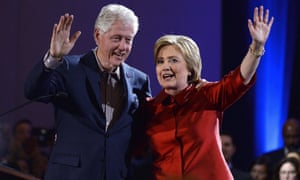
Former president Bill Clinton campaigns with the Democratic frontrunner for president, Hillary Clinton. Photograph: Mike Nelson/EPA
Like the upcoming sequel to Hollywood’s 1996 blockbuster Independence Day, this summer Bill Clinton is hoping to revive the spirit of the 90s after two decades away from the White House.
Frailer, thinner and with a now whispery stage voice, the 42nd president of the United States has captured attention by revealing a deal with his wife Hillary toserve as an economic adviser should she defeat Donald Trump in November’s general election.
But just as the film’s writers updated their script to put a woman in the new Oval Office – they memorably blew up the original – much has moved on since the last time a Clinton was behind the Resolute desk. What worked in the 1990s is no guarantee of box office success this time.
Though his exact role in any future administration remains unclear and a cabinet post has been ruled out, the emergence of William Jefferson Clinton as a central cast member in his wife’s 2016 campaign is already prompting a major reinterpretation of past performances.
From trade liberalisation and welfare reform, to gay rights and the war on drugs, the once-vaunted legislative successes of the first Clinton decade are being re-litigated in a very different America.
Trump has also begun to re-examine old scandals. He has tried to use Bill’s womanising as an antidote to his own alleged misogyny, and has threatened to dredge up everything from his affair with Monica Lewinsky to the Whitewater property deals in an effort to smear his opponent in attack adverts.
“Nobody in this country was was worse than Bill Clinton with women. He was a disaster,” Trump recently claimed at a rally in Oregon, after his own record was challenged by his opponent’s campaign.
At least the Clintons have had time to develop a thick skin. “You think the stuff they said about [Hillary] is bad? They accused me of murder,” Bill Clintonresponded on Friday, referring to the conspiracy theories that followed the suicide of White House aide Vince Foster.
For many Democrats, the “first dude” – as Hillary once joked he might have to be called if she wins – nonetheless remains an unparalleled electoral asset.
Unlike Tony Blair’s war-tarnished reputation, the centrist tenets of Third Way politics in the US emerged relatively unscathed from Clinton’s eight years in office between 1993 and 2001.
The reputation of this political “big dog” for both growing the economy and bringing Republicans and Democrats together, though more fondly remembered on the left than the right, is a particular attraction at a time of partisan rancour and economic insecurity.
“There’s been one time in 50 years when we all grew together, and that’s when I had the honour to serve. And I would like to see it happen again,” boasted Bill Clinton during a speech to supporters in Kentucky where he first revealed his offer to help his wife revitalise impoverished regions like Appalachia and the Rust Belt.
But while this attention to what the former Clinton adviser James Carville once dubbed “the economy, stupid” makes just as much electoral sense now as then, there is far less consensus today that Clintonomics holds the necessary answers.
At least two phenomena can trace some roots in that insecurity: Trump’s capture of the Republican party and the remarkably persistent challenge ofBernie Sanders to Clinton’s Democratic nomination. Both rest on their shared critique of Clinton-era free trade deals, and both opponents target the 1994 North American Free Trade Agreement (Nafta) and the permanent normalisation of trade relations with China in October 2000, which they say began a hollowing of US manufacturing that accelerated under George W Bush and Barack Obama.
Sanders in particular has singled out Clinton’s reform of welfare entitlements for exacerbating US poverty rates and removing a vital safety net once the economy turned sour.
The collapse in middle class incomes since the banking crash of 2008 can also arguably be traced back to Clinton’s decision to remove many of the restraints on Wall Street.
Recently revealed documents show two separate attempts by bank-friendly advisers, in 1995 and 1997, to hurry Clinton into a repeal of the Glass-Steagall Act, which prevented investment banks, insurers and retail banks from merging.
A Financial Services Modernization Act was passed by Congress in 1999, giving retroactive clearance to the 1998 merger of Citigroup and Travelers Group. The law also unleashed a wave of Wall Street consolidation that was later blamed for forcing taxpayers to spend billions bailing out the enlarged banks after the subprime mortgage crisis.
Even Bill Clinton’s own labour secretary, Robert Reich, has become a major critic of the administration’s legacy – and emerged as a powerful cheerleader for Sanders instead.
As Sanders supporters come under pressure to rally around Clinton, Reich acknowledged this week that she would be preferable to Trump, but with words of faint praise.
“Don’t demonize or denigrate Hillary Clinton,” he wrote. “She’ll be an excellent president for the system we now have, even though Bernie would be the best president for the system we need.”
On the campaign trail, Bill Clinton has also become a magnet for critics of the criminal justice system, who claim his 1994 crime bill, passed during the so-called “war on drugs”, was responsible for incarcerating a lost generation of African American men.
“I don’t know how you would characterise the gang leaders who got 13-year-old kids hopped up on crack, sent them out onto the street to murder other African American children,” he angrily told Black Lives Matter protesters last month. “You are defending the people who kill the lives you say matter.”
Though the language sounded as dated as the policy, Clinton supporters argue some can be excused by the changing times and attitudes. Both Clintons, for example, have also been criticised by gay rights campaigners for supporting the Defense of Marriage Act in 1996, when public support for same sex marriage was far less common or vocal.
Ultimately, however, such issues reveal the limits of relying on 90s nostalgia to help propel the Clintons back into the White House. As it has with grunge music, electronic pagers and Tamagotchis, the world has moved on a long way.
This is a note to Clinton Democrats—a desperate plea, actually. Your candidate staged a winning convention in Philadelphia: big stars, tight messaging, and a compelling case against her rival, Donald Trump.
The Republican nominee followed up by smearing a war hero’s family, revealing his ignorance about Russia’s incursions into Ukraine, denying a relationship with Russian President Vladimir Putin that he had previously claimed, and failing to quell suspicions that his team changed the GOP platform to protect Putin’s interests.
Hillary Clinton may be rising in the polls as a result, which is good news for people like me across the political spectrum who find Trump to be vacuous, soulless, and temperamentally unfit for the presidency.
Yet I’m not angry at Trump; I expect him to be repugnant. I am angry at Clinton, because she followed up her convention with another unnecessary lie; another excuse for people to distrust her; another thin reed upon which undecided voters could justify a belated allegiance to a man who former New York Mayor Michael Bloomberg called “a dangerous demagogue.”
On Sunday, the former secretary of state told FOX News’ Chris Wallace that FBI Director James Comey cleared her of misleading the public about her rogue email server at the state department: “Director Comey said my answers were truthful, and what I’ve said is consistent with what I have told the American people, that there were decisions discussed and made to classify retroactively certain of the emails.”
That’s wrong and she knows it, which makes it a lie.
“Clinton is cherry-picking statements by Comey to preserve her narrative about the unusual setup of a private email server,” wroteWashington Post fact-checker Glenn Kessler, who awarded Clinton the maximum four “Pinocchios” for her whopper. “This allows her to skate past the more disturbing findings of the FBI investigation.”
Read here if you want to know about the FBI’s findings. In addition, her actions were an assault on the Freedom of Information Act and the hallowed concept of legislative oversight.
And yet, in my mind, the case against Clinton is not as disturbing as Trump’s mendacity, megalomania, intolerance, and intellectual slovenliness. With Clinton and Trump, the two most unpopular presidential candidates in the modern era, there is no equivalence.
I’m angry at Clinton because I expect better. The country needs better. I say again: If Trump becomes president, the world will have Clinton to blame.
Her dishonesty could push an unknown number of independent and undecided voters into Trump’s camp or toward a non-major-party candidate. If too many swing voters walk away from Clinton because she destroyed her credibility or because they don’t want to condone her behavior, the nuclear codes go to Trump.
That is why Clinton’s advisers, senior Democrats, and members of the liberal media need to stop covering for Clinton. Stop repeating her spin. Stop spreading her lies. Stop enabling her worse angels. It’s too late for Clinton to come clean, but honorable Democrats should at least insist that she stop muddying the water.
Please, for the sake of the country, tell her: Stop lying.
A Wall Street analyst has discovered a scheme of financial irregularities, and it’s bad news for the Hillary Clinton campaign. Financial advisor Charles Ortel has taken on the Clinton Foundation and says that based on the records he’s found, the organization has been operating in a “boldly illegal” fashion, calling it “charity fraud.”
To avoid sources being identified, donations to the Clinton Foundation are primarily funneled through Canadian corporations, and then finally to the Clinton Foundation.
“WHEN YOU UNDERSTAND RELEVANT ACCOUNTING RULES AND LAWS, YOU WILL REACH A SIMPLE CONCLUSION: THE CLINTON FOUNDATION (INCLUDING ALL OF ITS VARIOUS CORPORATE SUBSIDIARIES AND “INITIATIVES”) HAS BEEN OPERATING BOLDLY AND ILLEGALLY OUT OF CONTROL, IN PLAIN VIEW OF THE GENERAL PUBLIC AND GOVERNMENT AUTHORITIES…”
Ortel has spent the past 15 months looking at public records, donor disclosures, and tax filings for all of the Foundation’s projects, including the Clinton Global Initiative, and the Clinton Health Access Initiative. Ortel plans to release the reports on what he found on his website, and he claims those reports will prove that the Clinton Foundation has never had to comply with legal requirements to verify their financial claims with independent accountants. Because of this, there is no way to trace billions of dollars sent to the Clinton foundation since 2000 because of the noncompliance with state laws regarding fundraising registration, disclosure requirements, and auditing rules.
“THERE ARE MASSIVE DISCREPANCIES BETWEEN WHAT SOME OF THE MAJOR DONORS SAY THEY GAVE TO THE CLINTON FOUNDATION”
Ortel wasn’t the only one finding discrepancies, and the Clinton Foundation was forced to issue corrected tax filings because of donation documentation errors over a period of several years. Unfortunately, Ortel says that despite filing “corrected” taxes, many of the discrepancies still remain, and the scheme continues.
“I’M AGAINST CHARITY FRAUD. I THINK PEOPLE IN BOTH PARTIES ARE AGAINST CHARITY FRAUD, AND THIS IS A CHARITY FRAUD.”
The former madam secretary gets personal at her peril.
Like her last book, Hillary Clinton’s political career has been long and tedious, with few, if any, stimulating parts. Because her recent past is uninspiring, Clinton is now showcasing her distant past — the era before anyone had heard of her.
“Americans don’t know the first 35 years of her life. And that’s not what happens with most candidates,” said Jennifer Palmieri, the campaign’s communications director. “They don’t emerge on the national scene without you understanding where they came from. So we thought it was important: Let’s go all the way back to what originally motivated her.”
Needless to say, if the best part of your political career occurred before your political career, there may be a problem with your political career. Such is the case with Clinton’s. According to a new Gallup poll, more voters view her unfavorably than favorably, giving Clinton her worst net favorable score since 2007.
The same woman whodeletedthousands of “personal” emails is now going out of her way to share details about her life, for the simple reason that everything else she has attempted —listening tours, policy speeches, other kinds of speeches,hiding from the press, going toChipotle, being a woman — has failed to galvanize prospective voters.
As in 2008, Clinton entered the 2016 presidential race hoping to win on account of her name or, failing that, her gender. Having failed to excite voters by simply existing, she now hopes to woo them with her personality, by telling them stuff they neither want nor need to hear.
A few weeks ago, at a rally in Hanover, N.H., Clinton mentioned that she once had a blind date at Dartmouth. “She is trying to give out more details like that,” according toThe New York Times.
The details are far from sensational. When talking about climate change in Iowa, Clinton remarked, “I’m just a grandmother with two eyes and a brain.”
In a recent economic speech, she reminisced about “watching my father sweat over the printing table in his small fabric shop in Chicago.” I suppose Americans are better informed knowing that her father’s fabric shop was small and located in Chicago, although it would have been helpful to hear more about his sweating habits.
Many people think this personality-centric approach will work. According to the Los Angeles Times, “there is value in Clinton sharing more about her personal story.” Mo Elleithee, a Democratic strategist who served as a spokesman during Clinton’s first presidential campaign, said his former boss erred in 2008 by “not opening up and letting people see who she was.” If only she had talked more about her blind dates, her eyes and her father’s fabric shop, she might have won the primary.
This is wishful thinking. If Clinton’s personality is her chief asset, she’s in trouble. To a lot of people, she comes across as neither affable nor interesting nor honest.
She has reinforced this impression over the years, often when trying to combat it. As First Lady, she wrote a syndicated newspaper column called “Talking It Over.” Its purpose was to dispell her acrimonious image, to exhibit her thoughts and personality in the most anodyne and hence most appealing way possible. Its singular achievement is that it has been forgotten. In this respect, it was a roaring success.
When she didn’t bore readers, she tested their credulity. On the cusp of her 20th wedding anniversary, she wrote, “I know it sounds corny, but we love each other more now than when we married.”
If her personal emails included tidbits like these, she was right to delete them.
Even if Clinton were well liked, that would not solve her most fundamental problem, which is that she is well known. People get tired of even things they like. That is why popular TV shows get cancelled, why bands that used to fill auditoriums no longer do, and why more people would rather listen to Bernie Sanders and Vanilla Ice than to Hillary Clinton.